"Docteur, j'ai besoin d'une radiothérapie. J'ai entendu parler de photons et de protons. Lequel dois-je choisir ?" C'est l'une des questions les plus fréquentes que nous entendons à la clinique. Cette confusion se comprend parfaitement. Au fond, le bon choix dépend d'une question :pour ma tumeur, quelle approche peut porter le coup le plus fort au cancer tout en protégeant le reste de mon corps autant que possible ?
Ce guide est conçu pour vous aider à comprendre la logique derrière la recommandation de votre médecin — sans vous noyer dans le jargon. Commençons par comparer les deux armes principales.
Deux armes : en quoi sont-elles différentes ?
Toute radiothérapie utilise des rayonnements pour détruire les cellules cancéreuses. L'objectif fondamental est le même :détruire la tumeur tout en épargnant les tissus sains.Mais la radiothérapie existe sous différentes formes.
1. Selon le type de rayonnement
Rayons photoniques(y compris les rayons X et gamma) sont des ondes électromagnétiques qui traversent le corps. C'est la technologie de radiothérapie la plus éprouvée et la plus utilisée.
Rayons particulaires(notamment les faisceaux de protons et d'ions lourds) sont constitués de particules chargées. Ils possèdent une propriété physique unique : ils libèrent doucement leur énergie en pénétrant dans le corps, puis relâchent soudainement une bouffée d'énergie à une profondeur précise à l'intérieur de la tumeur. C'est comme une « charge de profondeur » qui coule vers la cible avant de détoner.
2. Selon la méthode d'administration
Radiothérapie à faisceau externe :La machine émet des rayonnements depuis l'extérieur du corps, comme un missile à longue portée. La radiothérapie photonique et protónica relèvent de cette catégorie.
Radiothérapie interne (curiethérapie) :Une source radioactive est placée directement à l'intérieur ou à côté de la tumeur, comme une mine terrestre. Les exemples incluent la curiethérapie du cancer du col de l'utérus et les implants de graines prostatiques.
Parmi ces options, le dilemme le plus fréquent est de choisir entre la radiothérapie photonique conventionnelle ou la protonthérapie plus précise. Voici une analogie simple pour comprendre la différence.
Radiothérapie photonique
Comme un puissantprojecteur. Il entre dans le corps, traverse la tumeur et ressort de l'autre côté. En chemin, il libère de l'énergie devant et derrière la cible. Pour donner à la tumeur une dose suffisante, le faisceau doit être assez large pour que des tissus environnants reçoivent inévitablement des radiations. C'est la technologie la plus répandue et la plus disponible.
Protonthérapie
Comme une intelligentecharge de profondeur. Grâce à lapic de Bragg, le faisceau de protons libère peu d'énergie en entrant dans le corps, puis déverse presque toute son énergie précisément sur la tumeur et s'arrête. Le tissu devant la tumeur reçoit une dose plus faible ; le tissu derrière la tumeur n'en reçoit presque pas.
En bref :L'avantage principal de la protonthérapie est de pouvoir délivrer la dose tumorale nécessaire tout en protégeant mieux les organes sains autour de la tumeur.
Quatre questions pour éclaircir le choix
Vous n'avez pas à prendre cette décision seul. Utilisez ces quatre dimensions comme cadre pour vos discussions avec l'équipe d'oncologie.
Question 1 : De quel type de tumeur s'agit-il ?
Certaines tumeurs se prêtent particulièrement bien à la protonthérapie en raison de leur localisation ou de leur sensibilité.
- Tumeurs pédiatriques et adolescentes :La protonthérapie peut réduire significativement l'impact sur la croissance et diminuer le risque de seconds cancers primitifs. Une étude de 2025 portant sur 151 enfants a montré que les taux cumulés de nécrose cérébrale symptomatique et de tumeurs intracrâniennes secondaires à 5 ans n'étaient que de 2,3 % et 2,7 % respectivement.
- Tumeurs près d'organes critiques :Les tumeurs au cerveau près du tronc cérébral, des nerfs optiques ou de la moelle épinière exigent une précision extrême. Une petite augmentation de dose peut provoquer cécité ou paralysie. La protonthérapie peut contrôler la tumeur tout en protégeant ces « lignes rouges » fonctionnelles.
- Tumeurs radioresistantes :Les chordomes de la base du crâne nécessitent des doses très élevées pour être contrôlés. La protonthérapie peut assurer cette frappe de précision à haute dose et améliorer le contrôle tumoral.
Question 2 : Le corps peut-il le tolérer ?
Cela renvoie à votre tolérance aux effets secondaires du traitement.
- Fonction cardiaque ou pulmonaire faible :Pour le cancer du sein de côté gauche, la protonthérapie peut réduire significativement l'irradiation cardiaque et pulmonaire. Une étude de 2025 a montré que la protonthérapie à modulation d'intensité (IMPT) réduisait la dose cardiaque moyenne d'environ 5,22 Gy et la dose pulmonaire moyenne d'environ 9,88 Gy par rapport à la VMAT photonique.
- Jeunes patients atteints de gliome de bas grade :Préserver la fonction cognitive est essentiel. Un essai de phase II de 2025 a montré que le taux de nouveau déclin cognitif après protonthérapie était de 26 % à 5 ans, et que la dysfonction neuroendocrinienne n'était que de 5,3 %.
Question 3 : Quel est l'objectif du traitement ?
- Intention curative :Nous voulons la dose la plus précise et suffisante pour éradiquer la tumeur. Les technologies qui protègent mieux les tissus normaux (comme la protonthérapie) sont avantageuses car elles permettent aux médecins d'augmenter la dose tumorale avec moins de complications.
- Intention palliative :Lorsque l'objectif est un soulagement rapide de la douleur due aux métastases osseuses ou de réduire un tumor compressant les voies respiratoires, des technologies rapides et largement disponibles (comme la radiothérapie photonique conventionnelle) sont souvent le choix le plus pratique.
Question 4 : Quelles sont les conditions réelles ?
Trois facteurs pratiques comptent :
- Disponibilité de l'équipement :Les centres de protonthérapie restent limités en nombre. Tout patient n'y a pas un accès pratique.
- Coût économique :Bien que les coûts initiaux soient plus élevés que la radiothérapie traditionnelle, la protonthérapie peut être plus rentable à long terme. Elle réduit significativement les effets secondaires tardifs tels que la perte auditive et la dysfonction endocrinienne, diminue le risque de seconds cancers primitifs et évite une rééducation coûteuse plus tard. D'avantage de mutuelles commerciales commencent aussi à prendre en charge la protonthérapie.
- Coût en temps :De la planification au traitement, la protonthérapie prend généralement plus de temps que la radiothérapie conventionnelle.
En conclusion
Choisir entre la radiothérapie photonique et protónica n'est pas simplement une question de technologie « meilleure ». Il s'agit de trouver le bon équilibre entre la biologie de la tumeur, l'état physique, les objectifs personnels et les réalités pratiques.
La protonthérapie au GCCC
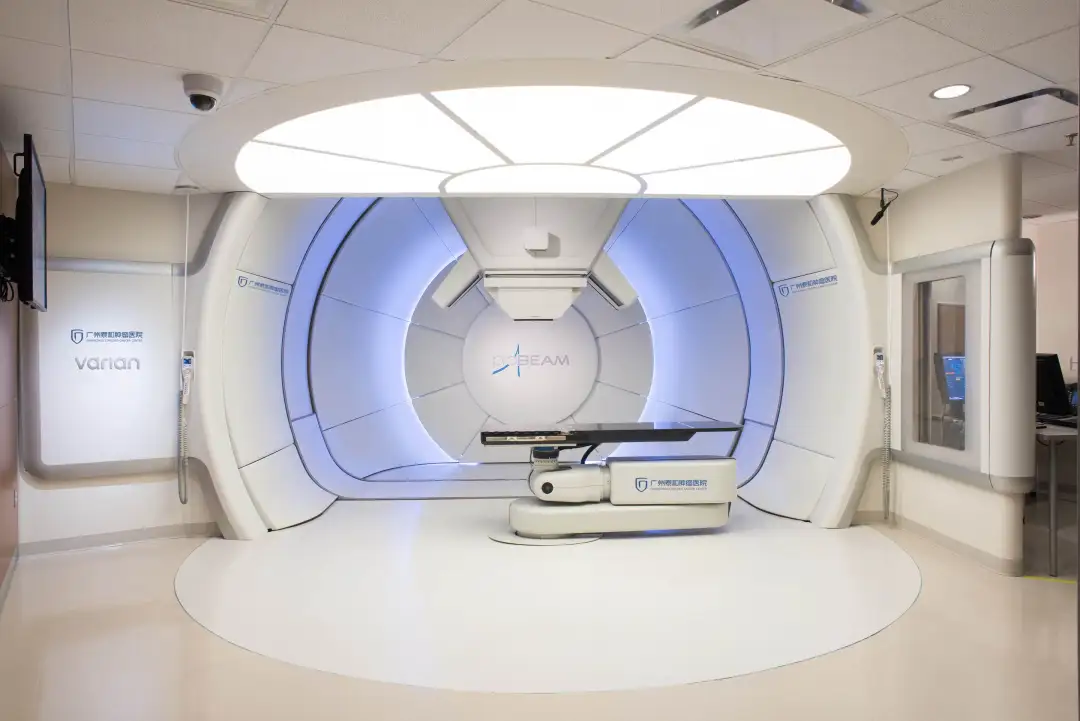
Premier centre de protonthérapie en exploitation clinique en Chine méridionale, le Guangzhou Concord Cancer Center est équipé duVarian ProBeam®système de protonthérapie. Nous suivons les protocoles de radiothérapie du MD Anderson Cancer Center pour proposer des plans de traitement individualisés et précis aux patients atteints de tumeurs complexes.
Notre équipe de protonthérapie possède une grande expérience du traitement des tumeurs pédiatriques, des chordomes de la base du crâne, du cancer de la prostate, du cancer du sein et d'autres tumeurs où la protection des organes environnants est cruciale.
Vous ne savez pas quelle radiothérapie vous convient ?
Notre équipe d'oncologie peut examiner votre dossier et expliquer si la radiothérapie photonique ou protónica convient mieux à votre diagnostic et à vos objectifs.
Demander une consultation gratuiteRéférences
- Indelicato DJ, et al. Late Outcomes of Pencil Beam Scanning Proton Therapy for Intracranial Tumors in Children and Adolescents.Int J Radiat Oncol Biol Phys. 2025;111(3):e45.
- Hayden A, et al. Radiotherapy for treatment of skull base chordoma.Cochrane Database Syst Rev. 2025;3:CD013491.
- Zhou P, et al. Effectiveness and Safety of Proton and Heavy Ion Therapy for Recurrent Skull Base Chordoma.J Craniofac Surg. 2025 Mar 19.
- Qiu J, et al. Dosimetric Comparison of Intensity-Modulated Proton Therapy and Volumetric-Modulated Arc Therapy for Bilateral Breast Cancer.Int J Part Ther. 2025;15:100785.
- Mast ME, et al. Left-sided breast cancer radiotherapy with and without breath-hold: Does IMRT reduce the cardiac dose even further?Radiother Oncol. 2013;108(2):248-53.
- Sherman JC, et al. Prospective Phase II Trial of Proton Beam Therapy for Low-Grade Glioma: Late Effects on Cognitive Function and Neuroendocrinology.J Clin Oncol. 2025;43(1):45-55.
- Vanderplas D, et al. Cognitive function in low-grade glioma patients considered for proton beam therapy.Neurooncol Pract. 2024;11(6):736-744.
- Deseyn D, et al. Cost-Effectiveness of Proton Therapy for Breast Cancer in a Modern Radiation Oncology Landscape.Int J Part Ther. 2025;15:100801.