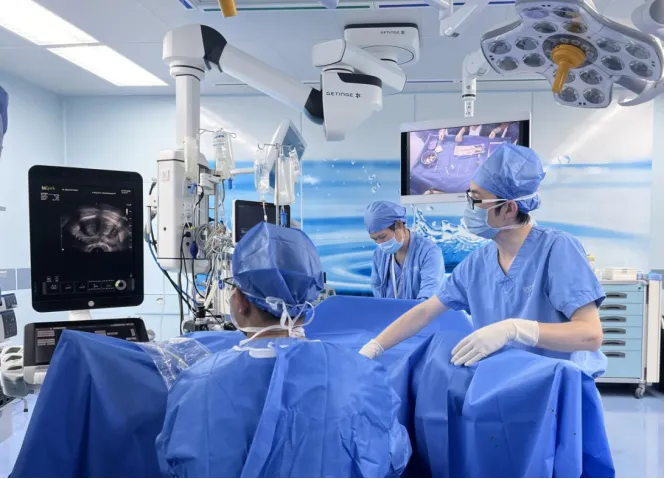
Le 27 janvier 2026, dans la salle d'opération à flux laminaire de classe 100 du Guangzhou Concord Cancer Center (GCCC), une équipe chirurgicale a réalisé l'« Implantation de l'espaceur rectal en hydrogel SpaceOAR » pour un patient atteint d'un cancer de la prostate. Toute la procédure n'a pris que 20 minutes — précise, sûre, et le patient est sorti après seulement 1 à 2 heures d'observation.
Il s'agissait de plus qu'une chirurgie réussie. Cela a fait du GCCC l'une des premières institutions médicales en Chine à adopter cette technologie internationale de pointe, et a marqué une nouvelle ère de précision pour la radiothérapie du cancer de la prostate au Guangdong.
Il convient de noter que le patient lui-même est un professionnel de santé. Après une recherche approfondie sur les technologies avancées, il a choisi proactivement cette approche. Sa décision reflète à la fois une considération attentive de la qualité de vie et l'approbation par un professionnel de la valeur de la technologie. Pour lui, cette couche de gel transparent injectée avec précision représente non seulement un tampon physique résorbable, mais un investissement actif dans la sécurité des soins et la qualité de vie.
Injecter une « couche de protection » : créer une distance de sécurité
La radiothérapie est l'un des traitements curatifs les plus importants pour le cancer de la prostate à risque faible à intermédiaire. De nombreuses études cliniques ont confirmé que son efficacité à long terme est comparable à la prostatectomie radicale.
Cependant, la radiothérapie se heurte à un défi clinique persistant : la proximité anatomique de la prostate avec le rectum signifie que la radiation à haute dose ciblant la tumeur peut causer des dommages collatéraux au rectum, entraînant une proctite radique et des symptômes intestinaux associés (saignements, diarrhée, etc.). Cela nuit non seulement à la qualité de vie, mais peut parfois limiter l'achèvement du traitement radiothérapique complet.
L'application réussie par le GCCC de la technologie d'espaceur rectal en hydrogel SpaceOAR offre une solution innovante à ce défi. La technologie utilise un hydrogel polymère stérile, absorbable et à usage unique, injecté avec précision entre la prostate et le rectum pour créer une séparation physique temporaire d'environ 1,2 cm, éloignant la paroi antérieure du rectum de la zone de rayonnement à haute dose pendant le traitement.
Principaux bénéfices cliniques
- Protection rectale :Augmente la distance prostate-rectum, réduisant significativement la dose de rayonnement rectal et l'incidence d'entérotoxicité radique, améliorant la qualité de vie après radiothérapie.
- Préservation fonctionnelle :Réduit l'impact des radiations sur les tissus critiques environnants, aidant à préserver la fonction sexuelle.
- Sûr et biodégradable :L'hydrogel présente d'excellentes propriétés de biocompatibilité et est progressivement absorbé et hydrolysé par l'organisme environ 3 mois après la fin de la radiothérapie.
- Sécurité et observance du traitement renforcées :Permet aux patients de suivre l'intégralité du traitement radiothérapique curatif plus sûrement et confortablement.
De la protection de précision au coup de précision : la protonthérapie offre des bénéfices supérieurs
Si SpaceOAR construit une barrière de sécurité critique, le GCCC s'engage tout autant à introduire des technologies de radiothérapie avancées dans la pratique clinique pour de meilleurs résultats.
La protonthérapie, l'un des modes les plus avancés de la radiothérapie, exploite sa propriété physique unique du « pic de Bragg » pour concentrer la dose de rayonnement précisément dans la tumeur prostatique, en minimisant les dommages aux organes et tissus normaux environnants, et en réduisant la toxicité vésicale et rectale.

La recherche montre que la protonthérapie peutréduire de 80 % le rayonnement des organes près de la prostate, en minimisant l'exposition de la vessie, de l'intestin et des tissus sains environnants. Les hommes traités par protonthérapie présentent également des taux plus faibles d'impuissance et d'incontinence. Les données cliniques de l'University of Florida Proton Therapy Institute montrent que l'incidence d'effets secondaires rectaux de grade 3 ou plus après un traitement par protons pour un cancer de la prostate à risque faible à intermédiaire n'est que de0,9 %.
En tant que premier centre de protonthérapie en exploitation clinique en Chine méridionale, le Centre de protonthérapie du GCCC suit strictement les directives et protocoles standard de radiothérapie du MD Anderson Cancer Center, offrant des plans de traitement individualisés et de pointe. Le centre est équipé duVarian ProBeam® proton therapy system, dirigé par des experts de renommée nationale comptant des milliers de cas cliniques en protonthérapie.
Résultats cliniques au GCCC
Cas 1 — Adénocarcinome acineux de la prostate à risque intermédiaire :Après 28 séances de protonthérapie, le PSA sérique a chuté significativement à 0,652 ng/mL. L'imagerie de suivi n'a montré aucun signe de récurrence, et aucune toxicité significative n'a été observée tout au long du traitement.
Cas 2 — Maladie résiduelle après prostatectomie :Après l'achèvement du même traitement, le PSA s'est stabilisé à un niveau bas de 0,605 ng/mL. Les suivis ultérieurs n'ont montré aucune preuve de récurrence tumorale, et la qualité de vie n'a pas été significativement affectée.
"Dans l'ensemble, la technologie d'espaceur rectal en hydrogel SpaceOAR offre un moyen important de protection rectale pour les patients sous radiothérapie, tandis que la protonthérapie représente l'orientation future de la radiothérapie de précision. À l'avenir, notre hôpital continuera d'intégrer l'application clinique de multiples technologies avancées, offrant des plans de traitement individualisés plus sûrs et efficaces pour les patients, et protégeant mieux leur qualité de vie et leur santé fonctionnelle."
— Professeur Qian Chaonan, Président du Guangzhou Concord Cancer Center
Envisagez-vous un traitement du cancer de la prostate en Chine ?
Accédez à SpaceOAR + protonthérapie au centre de cancérologie leader du sud de la Chine. Coordination multilingue des patients internationaux disponible.
Demander une consultation