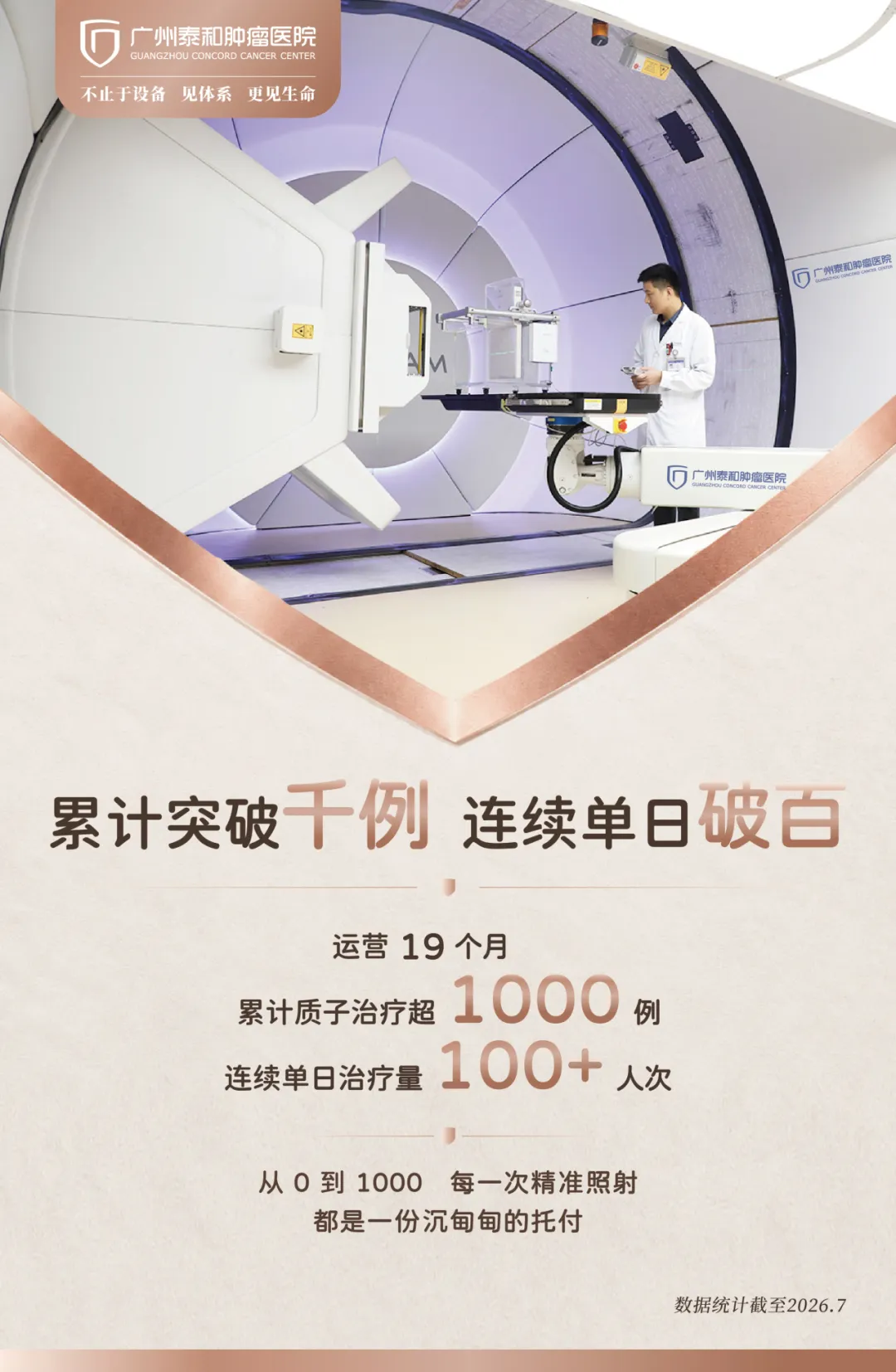
GCCC Proton Therapy Center celebrates treating over 1,000 patients in 19 months of operation, with consecutive daily volumes exceeding 100 sessions (data as of July 2026)
Since the ProBeam proton therapy system at Guangzhou Concord Cancer Center (GCCC) officially entered clinical application in December 2024, our hospital has provided proton radiotherapy to over 1,000 patients in 19 months, with consecutive daily treatment volumes exceeding 100 sessions.
World-Class Operational Efficiency
Compared to internationally comparable proton centers that have completed 1,000 clinical treatments:
- Emory Proton Therapy Center (USA) — launched December 2018, took approximately 2 years
- MIBS Proton Center (Russia) — trial operation September 2017, took approximately 2 years
- UCLH Proton Centre (UK) — launched December 2021, took nearly 4 years
- Tata Memorial Centre (India) — launched 2023, took nearly 3 years
- NCCS Proton Centre (Singapore) — launched June 2023, took 26 months to reach 500 cases
GCCC achieved the 1,000-patient milestone in just 19 months, placing its operational efficiency among the world's leading institutions.
Broad Clinical Indications
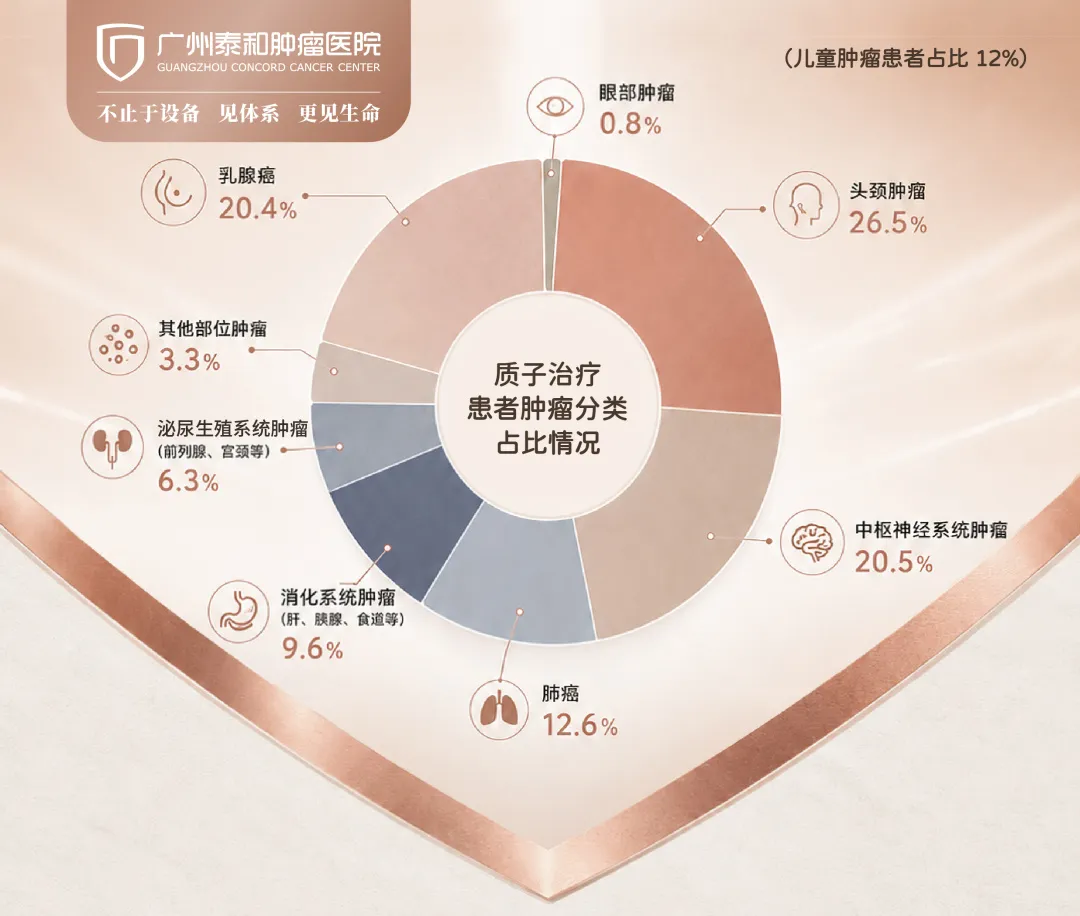
Proton therapy has wide clinical applicability. The cancer types treated at GCCC comprehensively cover dozens of solid tumors, including:
- Head and neck tumors
- Intracranial tumors (including gliomas, meningiomas, etc.)
- Lung cancer
- Breast cancer
- Digestive system tumors (liver cancer, pancreatic cancer, esophageal cancer, etc.)
- Urological tumors (prostate cancer, kidney cancer, etc.)
- Gynecological tumors (cervical cancer, endometrial cancer, etc.)
- Eye tumors
- Bone and soft tissue sarcomas
- Lymphoma
Outstanding Clinical Outcomes
Preliminary clinical observations show that patient tolerability is generally good, with acute toxicity rates significantly lower than conventional radiotherapy. While precisely irradiating tumors, proton therapy effectively protects adjacent vital organs, enabling patients to maintain a good quality of life. In the vast majority of cases, tumor lesions have significantly shrunk.
The age range of patients treated at Guangzhou Concord spans from 13 months to 91 years. Among them, over 120 patients are under 14 years old, achieving full age-range coverage. Patients come from all 32 provincial-level administrative regions across China. In recent years, demand from Hong Kong and Macau has continued to grow, with dozens of patients from these regions already benefiting from our services. At the same time, international patients from over 20 countries in Europe, America, Southeast Asia, and beyond have come to receive proton treatment at GCCC. The proton therapy service at Guangzhou Concord Cancer Center has earned widespread recognition from patients at home and abroad.
The Proton Escort Team: Five Roles, Precision Care
Precision radiotherapy is built on teamwork. For every patient receiving proton therapy at Guangzhou Concord, we assign an exclusive team — the "Proton Escort Team" — composed of five key roles:
Radiation Oncologist
Coordinates medical history collection, condition assessment, treatment planning, and end-to-end oversight to ensure precise and orderly treatment.
Medical Physicist
Responsible for treatment plan design, dose verification, and equipment quality control to ensure plan accuracy and device safety.
Radiation Therapist
Handles immobilization, simulation positioning, and daily setup for treatment, keeping positioning errors to a minimum.
Nurse
Manages admission assessment, condition monitoring, professional care, and emotional support so patients can complete treatment with peace of mind.
Case Manager
Coordinates every step, answers patient questions, and helps each patient navigate smoothly through the entire journey.
Precision cancer care is never the work of one person alone. It is the collaboration of a professional team, each contributing their expertise — transforming medical orders, plans, execution, care, and coordination into an organic, interlocking whole.
Full Closed-Loop Workflow: From Outpatient Evaluation to Treatment Completion
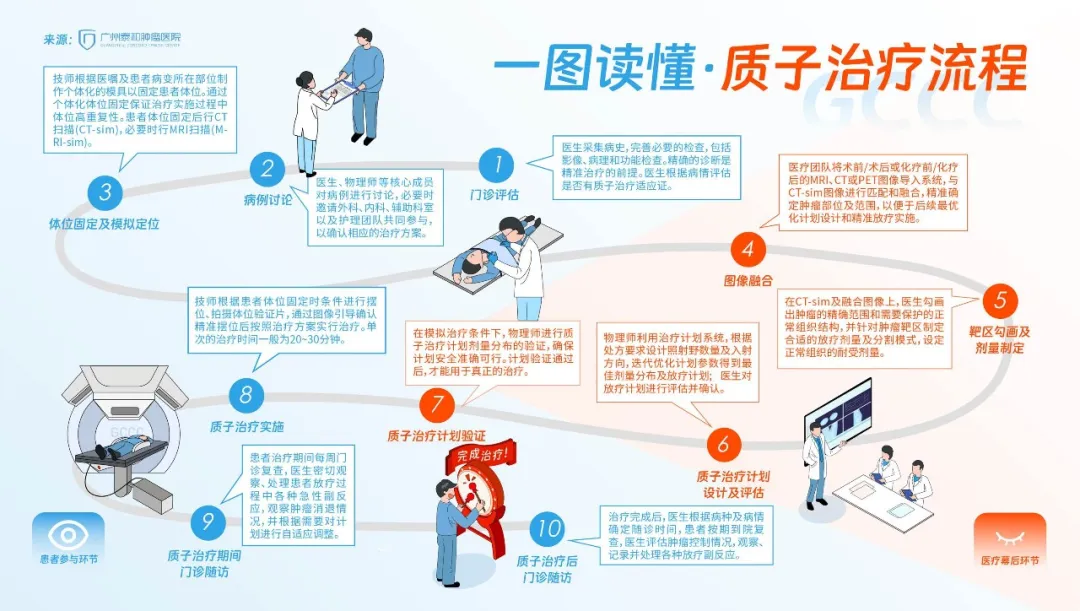
Systematic processes, sequential workflows. In terms of technical flow, the patient journey begins with outpatient evaluation, proceeds through MDT multidisciplinary case discussion drawing on cross-departmental expertise, followed by immobilization and simulation positioning, creation of individualized molds, and fusion of multi-modal imaging to precisely define target areas. After the radiation oncologist completes target contouring and dose prescription, the medical physicist conducts plan design and rigorous plan verification. Finally, the radiation therapist delivers treatment under image guidance, with each session taking approximately 20–30 minutes. All treatment plans undergo strict review by a senior expert panel, and full-process quality control is enforced throughout. Before treatment, precise positioning combined with image guidance and optical surface tracking technology minimizes errors to the greatest extent possible.
Accessible Payment Options
Medical Insurance
Guangzhou Concord Cancer Center is a designated specialty cancer hospital. For insured individuals under the Guangzhou Employee Medical Insurance or Urban-Rural Resident Medical Insurance (including minors and students), no advance selection of a "designated hospital" ("small point" or "large point") is required when visiting our hospital. Compliant medical expenses related to tumor conditions can be directly settled through medical insurance according to regulations, with patients enjoying corresponding insurance benefits.
Commercial Insurance Direct Billing
We have partnered with nearly 30 insurance companies and TPA service providers — including AIA, CPIC, MSH International, Cigna, Ping An Health, Taikang Pension, and others — to offer one-stop direct settlement channels, enabling cash-free direct billing: simply sign and go.
Inclusive Commercial Supplementary Health Insurance
Proton therapy has been included in the coverage scope of inclusive commercial supplementary health insurance products such as Guangzhou "Suixinbao" and Shenzhen "Huiminbao." Furthermore, the single-course cost of proton therapy at our hospital has achieved tiered coverage through a diversified payment system, further broadening protection channels and reducing the financial burden on patients, so that more patients can benefit from low-toxicity, high-precision radiotherapy.
Guangzhou Concord takes this milestone as a new starting point, continuously enhancing diagnostic and treatment capabilities, optimizing treatment processes guided by patient needs, deepening clinical research and technological application, and striving to bring precise, low-side-effect proton therapy to more patients.