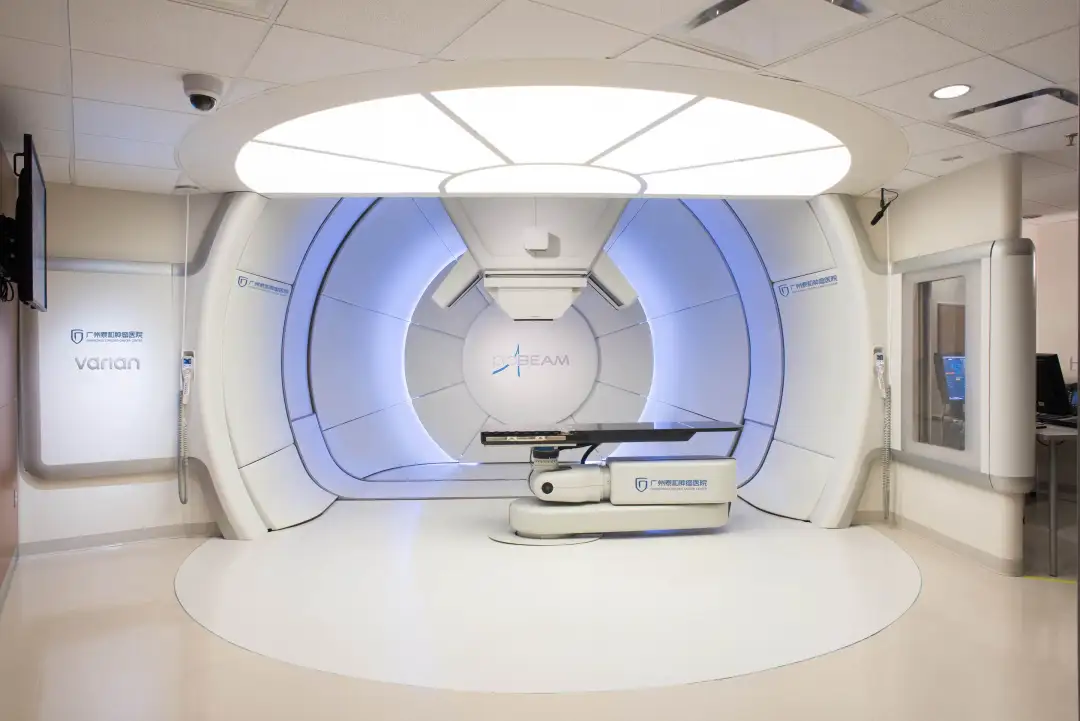
Proton therapy center at Guangzhou Concord Cancer Center — South China's first Varian ProBeam system
Since mid-March 2026, every weekday, a young Indonesian man named Rafi (a pseudonym) arrives punctually at Guangzhou Concord Cancer Center (GCCC) to receive his proton therapy session — each lasting about twenty minutes. After leaving the hospital, he and his wife make it a habit to take a gentle stroll along the nearby park trail, relaxing amidst the fragrance of grass and trees.
"Here, we don't need to say much. A smartphone can handle almost everything — it's very convenient."
— Rafi
Rafi says with a smile that he also truly enjoys the cuisine in Guangzhou. For this young couple who traveled across the ocean to seek medical treatment, this journey is not only about accessing better care but also a rare opportunity to focus on each other.
Christmas Eve Crisis: Diagnosed with a One-in-a-Million Tumor
On the surface, it is hard to tell that Rafi recently went through a health crisis. On Christmas Eve of 2025, he was unable to get out of bed due to severe back pain and was taken to the hospital by ambulance. The test results pointed to a rare tumor with an incidence rate of only about one in a million — chordoma.
Patient Snapshot
| Patient | Rafi (pseudonym), male, young adult |
| Country | Indonesia |
| Diagnosis | Chordoma (~1 per million) |
| Tumor Size | ~10 cm at diagnosis |
| Treatment | Surgery (Jan 2026) + Proton Therapy (from Mar 2026) |
| Sessions | ~20 min per session, daily on weekdays |
The Global Search: Why Proton Therapy?
After a brief hospital stay in Indonesia, the couple traveled to Penang, Malaysia, in search of hope. However, the treatment recommendation from local experts gave them pause: while surgery was necessary, it would likely require partial removal of the coccyx and could have long-term effects on bodily function and quality of life.
"That was not the option we wanted."
— Rafi
Why Proton Therapy for Chordoma?
During subsequent consultations, a key piece of information gradually emerged: for chordoma — a type of tumor that is not sensitive to conventional radiotherapy — proton therapy may be a better option. For this reason, proton therapy has become one of the standard radiotherapy techniques recommended by international guidelines for postoperative adjuvant treatment.
The Bragg Peak Advantage
Unlike conventional radiotherapy, which deposits energy along its entire path through the body, proton therapy concentrates the majority of its energy at a precise depth — the Bragg peak. This means:
- Maximum dose delivered precisely to the tumor bed
- Minimal dose to surrounding healthy tissue and critical organs
- Significantly reduced risk of radiation-induced secondary cancers
- Ideal for tumors adjacent to the spinal cord, brainstem, and other critical structures
Why Guangzhou Concord Cancer Center?
However, neither Indonesia nor Malaysia has proton therapy equipment. So Rafi's wife began searching globally for medical centers that offer this technology. India, Japan, Singapore, China — one by one, they were considered.
"We chose GCCC for three reasons," Rafi recalled. "The cancer center here has a very good reputation. Compared with Singapore, the cost is more favorable. And my wife has always liked Guangzhou — life here is very convenient."
— Rafi
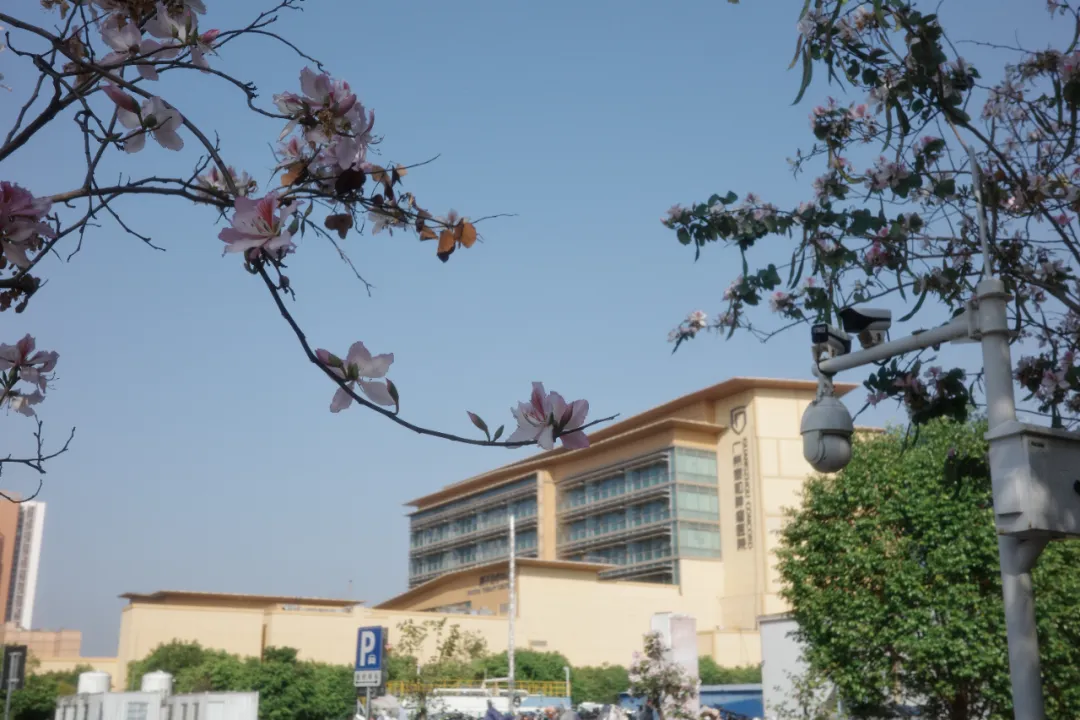
Guangzhou Concord Cancer Center in spring (Photo: 黄心盛)
Lightning-Fast Response: From Inquiry to Confirmation in 3–4 Days
"From leaving a message on the hospital's website to receiving confirmation that I could be treated, the whole process took only three or four days — the response was very fast."
— Rafi
"When I first arrived in Guangzhou at 10 p.m., the hospital staff had already arranged airport pickup, and communication was very smooth."
Surgery + Proton Therapy: An Integrated Treatment Strategy
After a comprehensive evaluation, the expert team in Guangzhou noted that Rafi's tumor was large (about 10 cm) and recommended that a top domestic surgical team first perform tumor resection surgery, aiming to remove as much of the lesion as safely possible. After surgery, proton therapy would be used to precisely "clear" any remaining cancer cells — maximizing protection of neurological function while systematically reducing the risk of recurrence.
"What you need now is postoperative adjuvant radiotherapy. Since there is no visible tumor in the tumor bed area, our goal is to prevent recurrence. The proton beam can precisely cover the entire tumor bed area and concentrate the high-dose energy on the tumor region, thereby better protecting surrounding vital organs such as the heart and lungs."
— Dr. Taize Yuan, Director of Radiation Oncology, GCCC
At the end of January 2026, Rafi successfully underwent tumor resection surgery. "The surgery was very successful — the tumor was completely removed." Then in February, he returned to GCCC for postoperative evaluation. Dr. Taize Yuan, Director of the Department of Radiation Oncology, explained the necessity of postoperative adjuvant radiotherapy and the advantages of proton technology.
More Than a Patient: The Human Side of Cancer Care
"The doctors and nurses here are very special. They don't just treat me as a patient — they are more like friends."
— Rafi
Outside of treatment, his daily routine with his wife is simple and grounded. In their free time, they often take the subway from the Knowledge City in the east all the way west, crossing the Pearl River and entering the bustling old town. They wander casually through the crowds on Beijing Road, pause in front of the historic former residence of Bruce Lee — these vivid glimpses of the city form the gentle backdrop to this special chapter of their lives.
What This Means for Rare Tumor Patients Globally
Rafi's journey is more than one patient's story. It illuminates a broader reality for patients with rare cancers worldwide:
- Limited local options. Neither Indonesia nor Malaysia had proton therapy. For rare tumors requiring highly specialized treatment, geographic access remains a critical barrier.
- Standard guidelines matter. International clinical guidelines increasingly recommend proton therapy as the standard of care for chordoma — but access to this technology is concentrated in a handful of countries.
- China as an emerging destination. With world-class proton centers like GCCC's Varian ProBeam system, China is rapidly becoming a viable and cost-competitive option for international patients seeking advanced radiotherapy.
- Integrated care wins. The combination of expert surgery + precision proton therapy, supported by comprehensive international patient services, delivers outcomes that no single modality could achieve alone.
- Quality of life is non-negotiable. Rafi's decision to reject the Penang surgical plan was rooted in a commitment to preserving long-term function and dignity — a principle that GCCC's integrated approach respected fully.
Still undergoing treatment, Rafi continues his daily rhythm: the twenty-minute proton session, then a walk through the park with his wife, breathing in the fragrance of trees and grass. Half a world away from home, a young couple has found not just advanced medical technology, but a city that welcomes them, a team that treats them as friends, and a future worth fighting for.
Facing a Rare Cancer Diagnosis?
Contact GCCC's international patient team for a remote consultation on proton therapy and integrated cancer treatment options.
Request a Consultation